


Amour courtois: Courtly Love in Medieval Europe

Updated: Apr 27

Courtly love -- a concept that has fed into thousands of books, poems, movies and even video games. The phrase calls to mind the image of a gallant knight in shining armor, submitting himself heart and soul to a beautiful noblewoman of peerless character. However, there's more to courtly love than meets the eye. This May, Musick's Company will explore love, warfare and nobility in our next concert, "Medieval Chivalry: Tales of Knights and Courtly Love", but for now, join us as we take a deep dive into amour courtois.
The term "courtly love" appears in only one extant source: Provençal cortez amors in a late 12th-century poem by Peire d'Alvernhe. It is associated with the Provençal term fin'amor ("fine love") which appears frequently in poetry, as well as its German translation hohe Minne. Provençal also uses the terms verai'amors, bon'amors. Interestingly enough, the concept of courtly love is as broad and varied as the words used to describe it, with some scholars even claiming that there's no real definition, due to the inconsistent ways it appeared.

The practice of courtly love developed in the castle life of four regions: Aquitaine, Provence, Champagne and ducal Burgundy, from around the time of the First Crusade (1099). Eleanor of Aquitaine (1124–1204) brought ideals of courtly love from Aquitaine first to the court of France, then to England. Her daughter Marie, Countess of Champagne (1145–1198) brought courtly behavior to the Count of Champagne's court. Courtly love found expression in the lyric poems written by troubadours, such as William IX, Duke of Aquitaine, one of the first troubadour poets.
Poets adopted the terminology of feudalism, declaring themselves the vassal of an idealized highborn lady. This lady was typically the wife of his employer or lord, a lady of higher status, usually the rich and powerful female head of the castle. When her husband was away on Crusade or elsewhere, she dominated the household and cultural affairs; sometimes this was the case even when the husband was at home. The poet gave voice to the aspirations of the courtier class, for only nobility could engage in courtly love. This new kind of love saw nobility not based on wealth and family history, but on peerless character and moral actions.
By the late 12th century, Andreas Capellanus' highly influential work De amore had codified the rules of courtly love:
"Marriage is no real excuse for not loving."
"He who is not jealous cannot love."
"No one can be bound by a double love."
"When made public love rarely endures."

To claim that "courtly love" spawned directly from France, or even Europe, would do a disservice to the other cultures that clearly influenced these 12th century lover boys.
According to Gustave E. von Grunebaum, notions of "love for love's sake" and "exaltation of the beloved lady" can be traced back to Arabic literature of the 9th and 10th centuries. The ennobling power of love is overtly discussed in Risala fi'l-Ishq by Ibn Sina, as well as a variety of other Arabic literature. According to an argument outlined by María Rosa Menocal in The Arabic Role in Medieval Literary History (1987), in 11th-century Spain, a group of wandering poets appeared who would go from court to court, and sometimes travel to Christian courts in southern France, a situation closely mirroring what would happen in southern France about a century later. Contacts between these Spanish poets and the French troubadours were frequent. The metrical forms used by the Spanish poets resembled those later used by the troubadours.
![Illustration in the “earliest [known] and possibly truest copy” of Christine de Pizan's "Book of the Three Virtues".](https://static.wixstatic.com/media/8181e1_a1bc0fb7931649e5b7702d0a897d9ee5~mv2.png/v1/fill/w_980,h_637,al_c,q_90,usm_0.66_1.00_0.01,enc_avif,quality_auto/8181e1_a1bc0fb7931649e5b7702d0a897d9ee5~mv2.png)
While we often take the practice of courtly love as a given fact today, scholars still debate whether or not real people participated in these behaviors. Historian John F. Benton found no documentary evidence in law codes, court cases, chronicles or other historical documents. However, the existence of the non-fiction genre of courtesy books is perhaps evidence for its practice. For example, according to Christine de Pizan's courtesy book Book of the Three Virtues (c. 1405), which expresses disapproval of courtly love, the convention was being used to justify and cover up illicit love affairs. Philip le Bon, in his Feast of the Pheasant in 1454, relied on parables drawn from courtly love to incite his nobles to swear to participate in an anticipated crusade, while well into the 15th century numerous actual political and social conventions were largely based on the formulas dictated by the "rules" of courtly love.
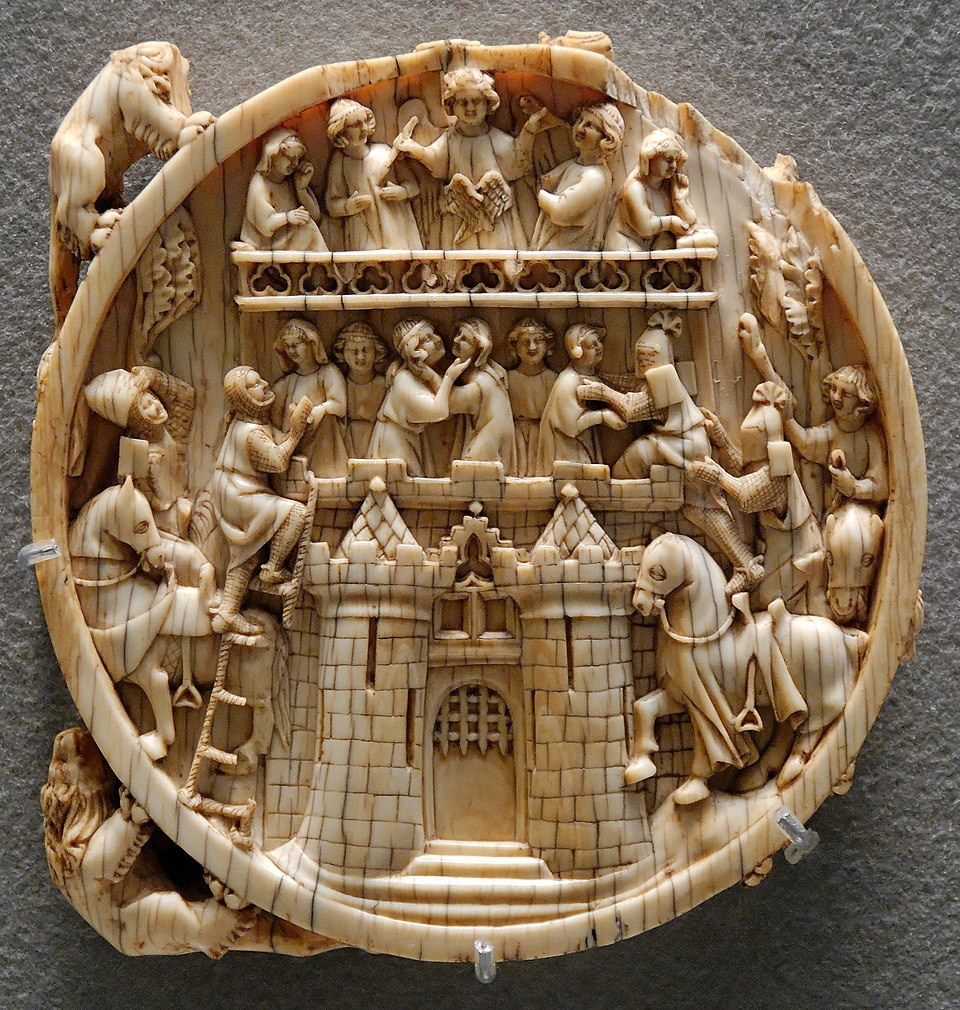
Courtly love and music have always been intertwined, with the concept first appearing with Provençal poets in the 11th century, itinerant and courtly minstrels such as the French troubadours and trouvères, as well as the writers of lays. Texts about courtly love, including lays, were often set to music by troubadours or minstrels. According to scholar Ardis Butterfield, courtly love is "the air which many genres of troubadour song breathe". We can infer that the pieces were performed at court by troubadours, trouvères, or the courtiers themselves, because these texts encourage and praise the sorts of behaviors expected of them.

Most of the information we possess on these topics is provided in the music itself. One lay, the "Lay of Lecheor", says that after a lay was composed, "Then the lay was preserved / Until it was known everywhere / For those who were skilled musicians / On viol, harp and rote / Carried it forth from that region…" Period examples of performance practice, of which there are few, show a quiet scene with a household servant performing for the king or lord and a few other people, usually unaccompanied. According to scholar Christopher Page, whether or not a piece was accompanied depended on the availability of instruments and people to accompany—in a courtly setting. For troubadours or minstrels, pieces were often accompanied by fiddle, also called a vielle, or a harp. Courtly musicians also played the vielle and the harp, as well as different types of viols and flutes.
If you want to see medieval songs of courtly love performed live in 2026, you don't have to look further than your own backyard! Musick's Company will present "Medieval Chivalry: Tales of Knights and Courtly Love", on May 31st at 4:00 pm, at Crestwood Christian Church! Additionally, stay tuned for more posts about knights, chivalry and the music they made. If you enjoy the content we post, please consider a donation to The Center for Old Music in the New World. Until next time, we bid you adieu.


Comments